
Edict: Robb Moser
Genesis to Revelation Bible Blogs

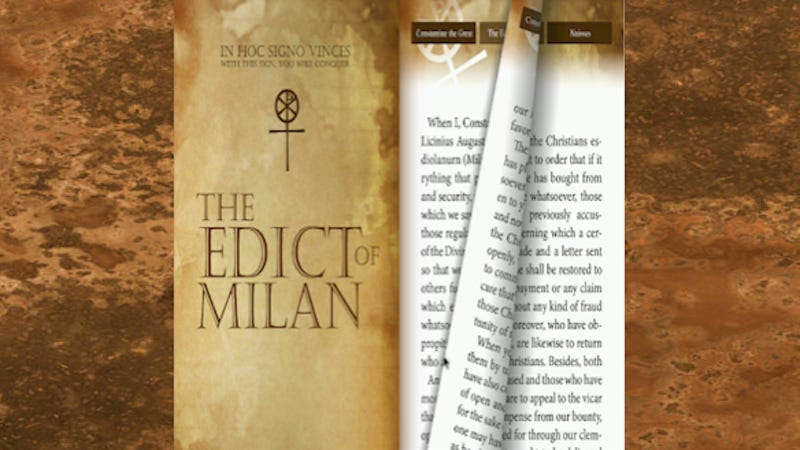
The Edict of Milan (AD 313) was a landmark political agreement between Roman emperors Constantine I and Licinius that permanently established religious toleration for Christianity within the Roman Empire. According to accounts by Lactantius and Eusebius of Caesarea, the agreement mandated several critical changes:
Legal Recognition: Christianity was granted legal status, effectively ending centuries of state-sanctioned persecution.
Freedom of Worship: It guaranteed all persons the right to practice their chosen religion without state interference.
Restoration of Property: The edict ordered the immediate return of confiscated properties, including churches and meeting places, to Christian communities without charge.
Historical Context & Significance
Political Alliance: The proclamation followed the Battle of the Milvian Bridge (312 AD), where Constantine defeated his rival Maxentius. He and Licinius met in Milan to solidify their power and public welfare policies.
Not the State Religion: A common misconception is that the Edict of Milan made Christianity the official state religion. This did not occur until the Edict of Thessalonica in 380 AD under Emperor Theodosius I.
Scholarly Perspective: Many historians now view the “Edict” as a collection of imperial letters sent to governors rather than a single formal legislative document.
The Edict of Thessalonica (also known as Cunctos populos) was a landmark decree issued on February 27, 380 AD, that made Nicene Christianity the official state religion of the Roman Empire.
The decree was jointly issued by three reigning emperors—Theodosius I, Gratian, and Valentinian II—though it was primarily driven by Theodosius following his baptism in Thessalonica. It fundamentally shifted Roman religious policy from the tolerance established by the Edict of Milan (313 AD) to the mandatory enforcement of a specific Christian orthodoxy.
Key Provisions of the Edict
The edict specifically mandated that all subjects follow the faith taught by the bishops of Rome and Alexandria, emphasizing the Trinity:
Official Orthodoxy: It required belief in the “one deity of the Father, the Son and the Holy Spirit, in equal majesty and in a holy Trinity”.
Establishment of “Catholic Christians”: Those following this law were authorized to use the title “Catholic Christians”.
Condemnation of Heresy: It branded all other Christian sects, particularly Arianism, as “foolish madmen” and “heretics”.
Enforcement: The edict authorized the state to punish those who did not comply, marking the first time secular law explicitly used “the power of the sword” to enforce religious conformity.
Historical Significance
End of Arianism: The decree effectively ended decades of theological conflict by outlawing non-Nicene factions.
Church-State Fusion: It established the Theodosian Code as a mechanism for the state to manage the church, where the emperor essentially acted as the head of the church.
Decline of Paganism: While initially focused on Christian dissidents, the edict paved the way for subsequent laws in the 390s that banned pagan sacrifices and closed traditional temples.
Foundation of Medieval Europe: By establishing a unified religious identity, it shaped the development of Christian Europe for the next millennium.
The full text of the edict was later preserved in the Codex Theodosianus (XVI.1.2), serving as a legal cornerstone for the Christianized Roman state.